Which Restaurant Costs Can You Actually Cut? Controllable vs Uncontrollable Costs
8 min read
Sales come in 12% under budget and somebody says "we need to cut costs." Everyone nods. Then the meeting spends forty minutes discovering that most of the P&L can't move before the next quarter, and the only line anyone can actually change by Friday is the one that was generating the sales in the first place.
The usual framing — controllable vs uncontrollable restaurant costs — is the right instinct with the wrong resolution. It gets used to mean "the stuff the venue manager is responsible for" versus "the stuff head office decides," which is an accountability split, not a decision-making one. When trade drops, what you need to know is narrower and more urgent: what can this business actually change, and how soon?
Fixed vs variable answers a different question
Every operator already knows the fixed/variable split, because it's the one the breakeven calculation needs. But those two splits aren't the same split, and assuming they are is where the reasoning goes wrong.
Fixed vs variable answers: what happens to this cost if sales change? Controllable vs uncontrollable answers: what happens to this cost if I decide to change it?
Those come apart constantly:
| Line | Behaves as | Can you move it this quarter? |
|---|---|---|
| Cost of goods sold | Variable | Partly — recipe, supplier, portion, waste |
| Delivery commission | Variable | No — the rate is the rate |
| Brand marketing | Fixed | Yes — cancel it on Monday |
| Salaried payroll | Fixed | Not quickly, and not without consequences |
| Turnover rent | Variable | No |
| Staff meals | Fixed-ish | Yes, at a cost to morale |
Delivery commission rises and falls perfectly with sales and you have essentially no control over it. Brand marketing doesn't move with sales at all and you can switch it off this afternoon. The variable line is the uncontrollable one; the fixed line is the controllable one. A cost-cutting conversation run off the fixed/variable split will get this exactly backwards.
Unmitigable vs minimisable
The frame we build into group P&Ls is blunter, and operators take to it faster:
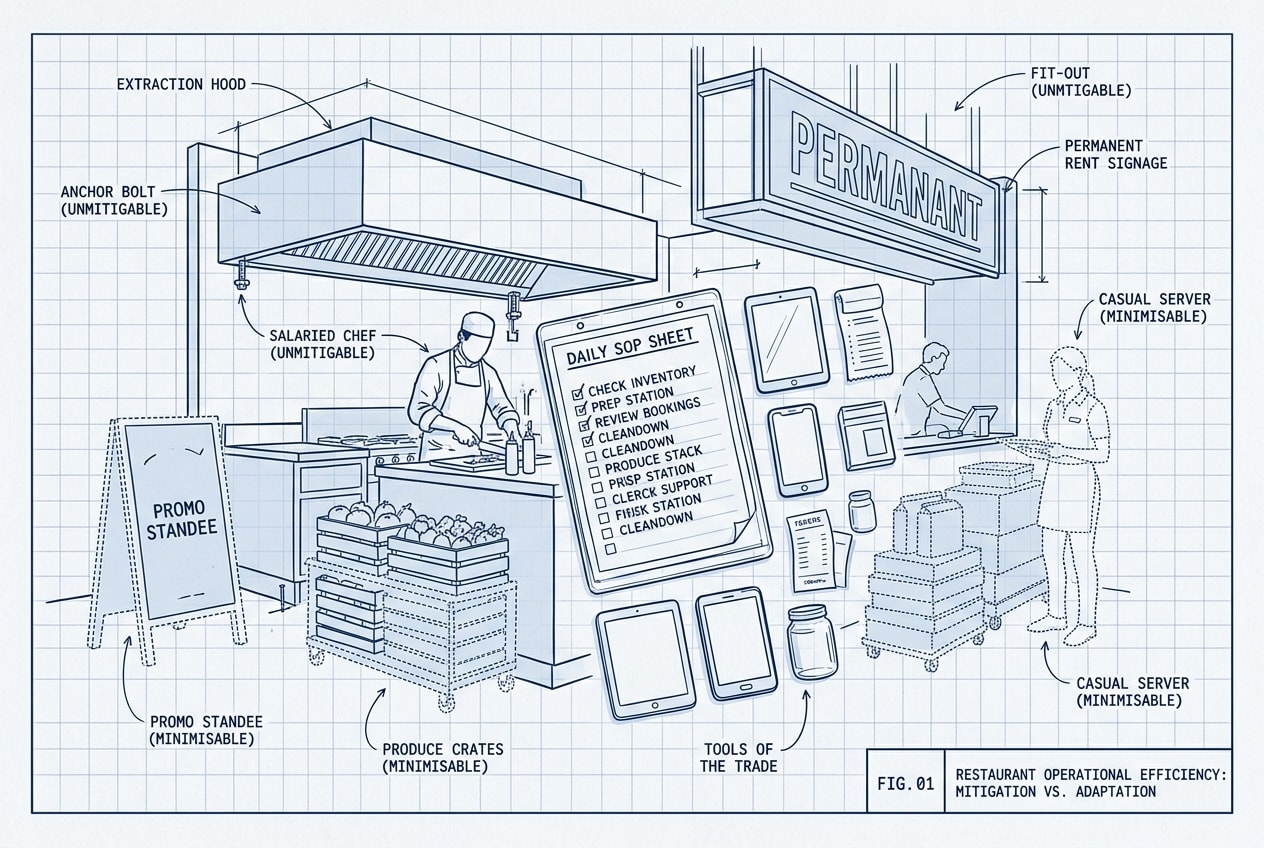
- Unmitigable — costs you've already committed to. Within the next quarter, they land whatever you do. Rent, salaried payroll, depreciation, interest, insurance, licences, the base utilities to keep a kitchen cold.
- Minimisable — costs that respond to a decision you can make now. Food cost, hourly rostering, promotion spend, packaging, brand marketing, staff-related spend, repairs you can defer.
One rule keeps it usable: the split is about time, not about virtue. Rent is unmitigable this quarter and entirely negotiable at renewal. Salaried payroll is unmitigable this month and a live decision over six. Set the horizon explicitly — a quarter works for most groups — and classify against it, rather than against whether the cost feels discretionary.
Going line by line
Working down the outlet from our group P&L structure, on a one-quarter horizon:
Rent — unmitigable. Signed years ago. The exception is turnover rent, which is uncontrollable but at least self-correcting: it falls when you do.
Depreciation and interest — unmitigable. The fit-out is in the ground and the loan is drawn.
Salaried payroll — unmitigable in practice. Technically you can restructure. Realistically, not inside a quarter, not without notice periods, and not without losing the people who'd have to run the recovery.
Delivery platform commission — unmitigable per order, minimisable in aggregate. You can't change the take rate by deciding to. You can change what share of your sales goes through it — first-party ordering, dine-in promotions, a delivery menu priced to carry the commission. That's a strategy, not a cost cut, and it works on a horizon of quarters rather than weeks.
Card payment (MDR) fees — unmitigable rate, minimisable mix. Nudging customers toward lower-cost rails moves it a little. Nobody has ever saved a struggling venue this way, but it's worth knowing the number.
Food cost — minimisable, with an asterisk. You can't stop buying food. What you can cut is the gap between what your dishes should cost and what they do — over-portioning, waste, yield, receiving errors. That gap is usually worth more than every other line on this list combined, which is why we gave it its own post.
Hourly payroll — minimisable, weekly. The fastest-acting lever in the building, and the easiest one to pull too hard.
Promotion spend on delivery platforms — the most minimisable line you have. It's a decision made monthly, it can go to zero on notice, and in a soft month it's usually the first place to look.
Brand marketing, staff-related spend, repairs and maintenance — minimisable. Fixed in behaviour, discretionary in fact. Deferring maintenance is borrowing, not saving, but it is available.
Put a number on it
The frame only becomes useful when it's a ratio you can track. Take the same outlet: $100,000 in monthly sales, $95,040 of total costs including depreciation and interest.
| Month | % of total costs | |
|---|---|---|
| Unmitigable (rent, salaried payroll, base operating, depreciation, interest) | 37,500 | 39.5% |
| Minimisable (food, hourly labour, platform promo, packaging, marketing, staff-related) | 57,540 | 60.5% |
| Total cost base | 95,040 | 100% |
Two numbers come out of this, and both are worth putting on the outlet tab every month.
Unmitigable as a share of the cost base — 39.5%. Minimisable is simply the complement: 60.5%. This is the proportion of your costs that would still respond to management action if the month went badly.
Unmitigable as a share of sales — 37.5%. This is the burn floor. If trade stopped tomorrow, this venue would still consume roughly $37,500 a month until something structural changed. Divide it by your cash reserve and you have a runway, in months, that means something.
What the ratio tells you
Compared across outlets. A venue at 30% unmitigable can trade its way out of a bad quarter. A venue at 55% mostly cannot — its recovery has to come from sales, because there isn't enough movable cost left to matter. Same group, same brand, completely different responses to the same downturn. Head office should know which venues are which before the downturn.
As a lease test. Rent is the biggest unmitigable cost most groups ever sign. Run the prospective unmitigable ratio on a new site before signing, not after the first slow quarter.
As a trend. The ratio drifts upward quietly — a salaried hire here, a new subscription there, a rent review. A venue that was 35% unmitigable two years ago and is 48% now has lost most of its ability to absorb a bad month, and nothing in the standard P&L will have told anybody.
The trap: cutting the costs that make the sales
The minimisable list and the "safe to cut" list are not the same list, and treating them as one is how a soft quarter becomes a bad year.
Promotion spend, hourly labour and maintenance are the three fastest levers, and all three have a sales consequence at some depth. Cut promo and delivery volume follows it down. Cut the roster and service times stretch, which shows up in reviews about six weeks later. Defer maintenance and you buy a bigger bill with interest.
The honest way to use the split is as a map of what's available, ranked by what it costs you to use it. Food cost variance first — it's the one reduction with no downside, because you're removing waste rather than removing product. Then the promo spend that isn't earning its contribution margin. Then the rest, carefully, knowing what each one buys and what it breaks.
It's a policy, not a fact
Reasonable people will disagree on where half these lines belong. Is staff training unmitigable in a group that's opening two sites next year? Is the second sous chef fixed, or is that a decision you've simply never made? There's no universal answer, which is precisely why this classification should be a setting the business owns, not a rule baked into a report.
On the group P&Ls we build, the unmitigable/minimisable classification lives in the client's own configuration sheet, next to the account mappings and the ratio definitions. The finance lead moves a line from one bucket to the other and every outlet tab and the consol tab recalculate on the next run — no ticket, no developer, no waiting. It's a small thing that turns a static report into something the group argues with productively.
If your cost base has quietly become more committed than you realised, and nothing in your monthly pack shows it, that's worth a conversation.
The short version
- Controllable vs uncontrollable is about time: what can move this quarter?
- It isn't the same split as fixed vs variable — delivery commission is variable and uncontrollable, brand marketing is fixed and entirely controllable
- Track unmitigable as a share of costs, and as a share of sales — the second is your burn floor
- Compare the ratio across outlets and watch it drift upward over time
- The most minimisable cost with no downside is food cost variance; cut that before touching anything that generates sales
- Where each line sits is a management policy, so keep it in a config the finance team controls

Jarvin
Finance × Operations × Software. I build operations platforms for F&B businesses — for people who’d rather be running their business than building their tools.
Fig. 01 / BriefRev. A
Want to talk shop?
Tell us what’s slowing you down.